iW-AIoT-eXplorer
The iW-AIoT-eXplorer is a development platform from Indústrias William aimed at exploring AIoT — the convergence of Artificial Intelligence and the Internet of Things. It is built around the ESP32-S3R8 SoC (Xtensa LX7 dual-core, up to 240 MHz) with 8 MB of integrated PSRAM and a vector accelerator for neural-network inference, plus Wi-Fi and Bluetooth 5 LE.
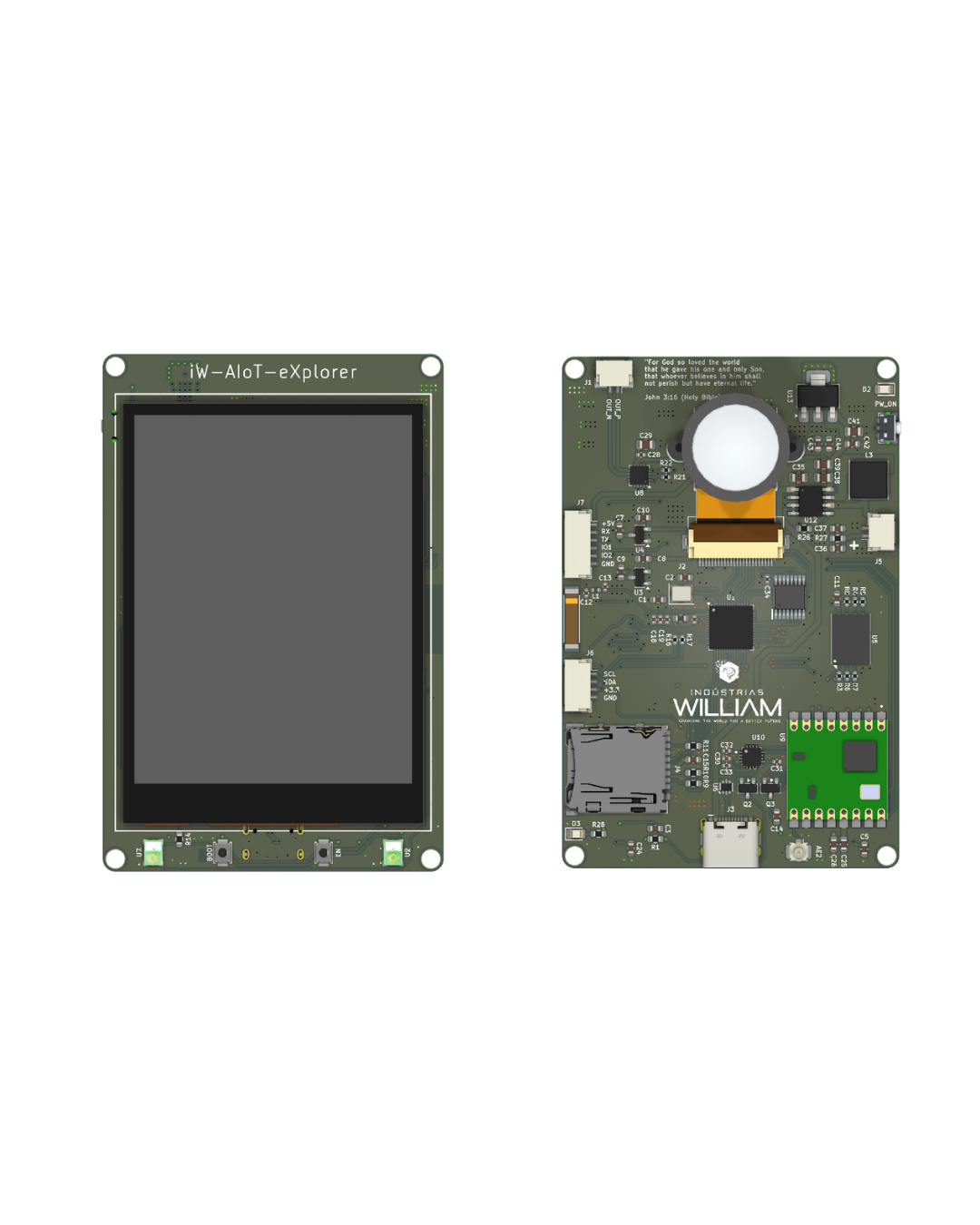
Around the SoC, the board brings together everything an embedded AI project with audio and vision needs: a 5 MP OV5640 camera, two PDM digital microphones in a stereo arrangement, a Class-D audio output, a 3.5" IPS display with capacitive touch, a 3-axis accelerometer, a microSD card and long-range LoRa / LoRaWAN connectivity at 915 MHz. Power via a PMIC with a battery charger enables autonomous field operation.
Highlights
ESP32-S3R8SoC (Xtensa LX7 dual-core, 8 MB PSRAM) with acceleration for TinyML / Edge AI- 5 MP
OV5640camera (DVP + SCCB) for computer vision - 2x PDM digital microphones
IMP34DT05(stereo) for keyword spotting and sound classification - Class-D
MAX98357Aaudio output (I2S) - 3.5" 320x240 IPS display
ST7789with capacitive touch - 3-axis
LIS3DHaccelerometer LoRa / LoRaWAN RFM95Wradio (SX1276) at 915 MHz- 16 MB or 32 MB of QSPI flash + microSD card
- Wi-Fi 802.11 b/g/n + Bluetooth 5 LE / Mesh
IP5306PMIC with Li-ion battery and USB-C with automatic flashing
Suggested applications
- computer vision at the edge and image recognition
- keyword spotting and voice command
- audio and sound classification
- LoRa / LoRaWAN sensor nodes and remote monitoring
- HMI interfaces with a touch display
- motion and gesture detection
- connected AIoT product prototypes
Compatibility
- ESP-IDF
- Arduino IDE
- LoRaWAN stacks such as RadioLib, LMIC or the ESP-IDF LoRaWAN API
Why this board stands out
The iW-AIoT-eXplorer brings together, on a single board, vision and audio sensors, an interactive display and two radio ranges (Wi-Fi/BLE for short range and LoRa for long range), all on top of an ESP32-S3 with abundant PSRAM and AI acceleration. This makes it possible to run local image and sound inference without depending on the cloud and, at the same time, connect the device to nearby networks or kilometers away.